The path to Charlottesville, home to the University of Virginia (UVA), remains well-trodden. It was designed by Thomas Jefferson, the third president of the United States. Jefferson was even more proud of this brainchild than he was of authoring the Declaration of Independence: he was directly involved not only in its planning and design, delving into even the most seemingly insignificant details, but also in the selection of curricula and faculty.
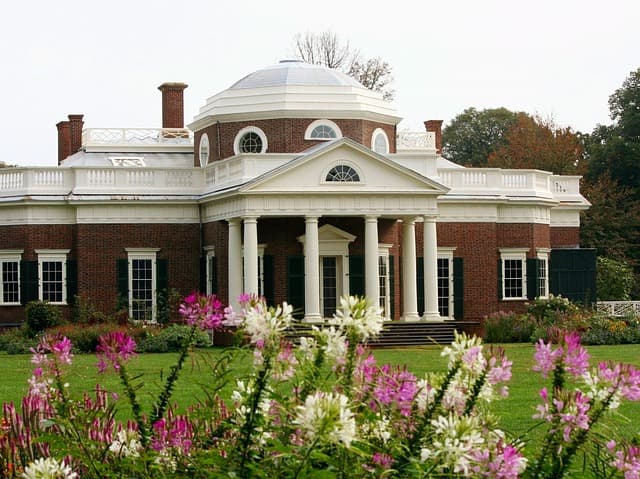
When residents of Charlottesville are asked what they think is most noteworthy, they immediately mention Jefferson’s estate, Monticello. And it’s not just a matter of patriotism or gratitude to the university’s founder. Monticello is one of the most beautiful and distinctive buildings in America.
Jefferson began designing and building it in 1768, when he was only 25 years old. He named it “Monticello” in the Italian style, which means “little mountain” and corresponds to its location: the house was built on a hill, five kilometers from Charlottesville. Jefferson moved here in 1770, shortly before the work was completed. Two years later, his young wife Martha settled here.
Although his political career—as Secretary of State, Vice President, and then President of the United States—kept Jefferson in Washington for a long time, Monticello always remained his true home, where he finally settled in 1809 after retiring from public life.
The mansion’s architecture embodies many ideas borrowed by Jefferson from French architects, whose work he became familiar with while serving as US ambassador to France. The house has 35 rooms, 10 of which—on the first and second floors—are open to visitors. Upon entering the spacious lobby of the mansion, visitors’ attention is drawn to a huge clock built into the wall with two dials, one showing the time and day of the week outside the entrance and the other inside the house. This is one of Jefferson’s inventions.
From the hall, visitors pass through the living room into the library, which contains two thousand volumes. Jefferson, who spoke seven languages, once said, “I cannot live without books.” At one time, his personal library contained about 7,000 volumes. In 1815, experiencing financial difficulties, he agreed to sell part of his books to the Library of Congress.
The doors from the library lead to Jefferson’s study. Here he read his correspondence and replied to it. Another presidential innovation: a bed built between the study and the bedroom, which can be accessed from either room. Next to the bed are his shoes, drawing supplies, and a telescope. Light enters the bedroom through a round window in the ceiling—also Jefferson’s idea, who placed a greenhouse on the first floor in addition to the aforementioned study, library, living room, and bedroom.
It must be said that Jefferson was as interested in gardening as he was in designing, rebuilding, and improving his mansion, which he worked on for forty years. He had a flower garden, a vegetable garden, two orchards, and a vineyard. The garden was adjacent to woodlands. Jefferson kept a detailed diary of his gardening work and innovations: no other plantation of that time has been described so meticulously and accurately, which made it possible to restore the gardens and vegetable gardens to the way they existed under Jefferson.
Monticello was located in the center of a plantation consisting of four farms. Tobacco, wheat, corn, and potatoes were grown here. Jefferson also kept cattle, pigs, and sheep. He was fond of breeding new varieties of vegetables and plants, many of which are still grown at Monticello today. In 1987, the Botanical Center opened at Monticello, where visitors can buy vegetables, fruits, and seeds grown there.
Jefferson was interested in everything: he was a politician and diplomat, farmer and scientist, teacher and inventor. He did research and wrote books on the structure of the universe, literature, and social systems. He collected paintings and books and kept chronological records of harvests and weather conditions. Here, at Monticello, he worked on the Declaration of Independence.
The tea room on the first floor still has the special wooden table where the greatest document in American history was drafted. Unfortunately, not much of the president’s personal belongings remain at Monticello: after his death, almost everything was sold to pay off debts.
For the 250th anniversary of Jefferson’s birth, Monticello was renovated, with every effort made to restore the mansion to its appearance during the president’s lifetime. A search conducted by historians across the country to mark this anniversary has borne fruit: the collection they have assembled consists of 150 of Jefferson’s personal belongings.
Following the lead of the locals, I repeat: if you happen to visit Charlottesville, be sure to visit Monticello, the home of America’s greatest statesman and thinker, Thomas Jefferson.