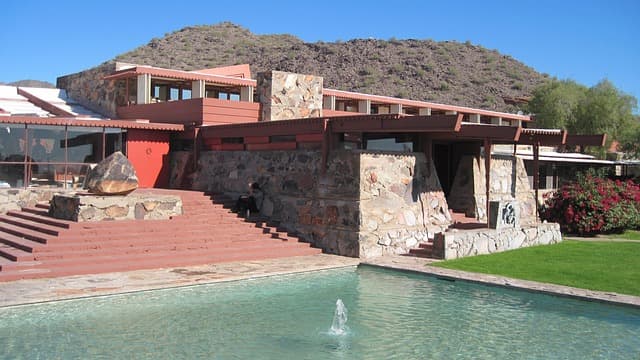
There are places you visit not for entertainment, but to experience something greater. This was the case for us when we traveled to Wisconsin to see Taliesin, the home and studio of the great American architect Frank Lloyd Wright.
The name Taliesin comes from the Welsh language and means “shining brow.” This is what Wright named his estate, which he built for himself and his family. He lived here for almost half a century, creating designs that changed world architecture.
I have seen many buildings designed by Wright, both in Chicago and beyond. But it is Taliesin that amazes with its scale and integrity of design. It is not just a single building, but an entire estate where nature, architecture, and life merge into a single whole.
Today, there are several tour options for visitors: one-hour, two-hour, two-and-a-half-hour, and even four-hour tours. We chose the 2.5-hour tour, which turned out to be perfect: enough time to immerse ourselves in the atmosphere, but not too long to be tiring.
Our guide was simply wonderful: he didn’t just recite dry facts, but told stories about Wright himself, his family, his students, and life on the estate. Thanks to him, I found myself thinking that I had been transported back a century and had become part of that world.
When we entered the house, the first thing that struck us was the view from the windows. There are no curtains here: Wright believed that the landscape was the main element of the interior. Moreover, he thought in advance about where the chairs and sofas would be placed so that the owners and guests could admire a specific view—a green meadow, a bend in the river, or a grove. I sat down by one of these windows and caught myself thinking that I didn’t want to get up at all—this “living picture” seemed so mesmerizing.
The interiors are also impressive: furniture and lamps based on his sketches, a huge stone fireplace, a workshop with drawing tables. Everything looks as if the owner of the house has stepped out for a moment and is about to return.
The second part of the tour takes place at Hillside School. There we saw drawing rooms, a dining room, and a real theater. A small stage, wooden walls, a cozy space — all this reminds us that life at Taliesin was filled not only with architecture, but also with music, performances, and communication. I could easily imagine Wright’s students putting on plays here, opening the doors, and filling the summer evening with voices and music.
Then there was a walk around the grounds: hills, ponds, pine and oak trees — Wright considered all of this part of his project. Here, you can clearly understand his idea of organic architecture — when the house and nature become one.
- An hour-long tour is suitable for a brief introduction, but to really get a feel for the atmosphere, it’s better to choose a two- or two-and-a-half-hour tour. True enthusiasts will appreciate the four-hour program.
- The tour guides here are truly top-notch—their lively commentary makes the tour unforgettable.
- It’s best to buy tickets in advance: there are many visitors, especially in summer.
- And most importantly: don’t forget to sit by the window and look at the scenery. It’s the best part of the whole tour.
Taliesin is not just a museum. It is the home where one of the greatest architects of the 20th century lived and worked. And as I left, I thought that perhaps this is what happiness looks like for an architect — living in a space that you have designed yourself, which reveals new views from the windows every morning.