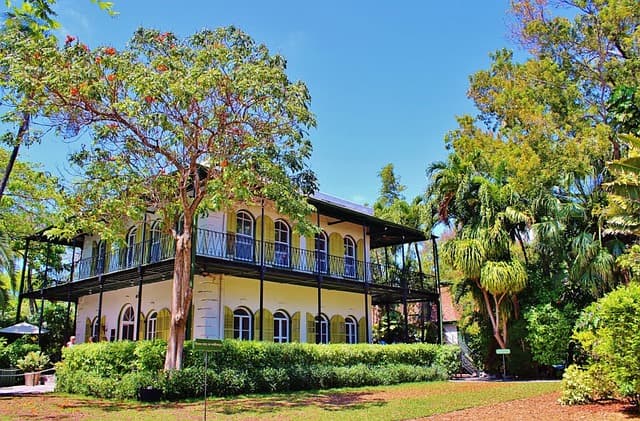
In April 1928, Ernest Hemingway and his wife, Pauline Pfeiffer, arrived in Key West for the first time, where they were to receive a brand new Ford Roadster, a gift to the newlyweds from Pauline’s wealthy uncle. The car got stuck on the way, and the forced three-week delay changed the young writer’s life. The newlyweds settled on Simonton Street, and Hemingway, not abandoning his Parisian habits, devoted himself to his work. It was during these days that one of the writer’s major novels, “A Farewell to Arms,” was completed.
Shortly after his arrival, Hemingway met a local merchant, Charles Thompson, who introduced the writer to the exciting world of real sea fishing. Hemingway carried this friendship and passion throughout his life, and perhaps they became the decisive argument in favor of Key West. In 1931, Ernest and Pauline finally decide to settle here. And again, a surprise from Pauline’s uncle: he buys them a house on Whitehead Street.
The large colonial-style house was built in the mid-19th century and had been vacant since the beginning of the 20th century. By the time Hemingway moved in, it had fallen into complete disrepair. But that didn’t stop the young couple. In just a few years, they not only restored the house, but also turned it into the center of cultural life in Florida. It was here that Hemingway achieved fame as a “great” writer: he worked hard, traveled extensively, and wrote one novel after another, which brought him fame as a great American writer and then the Nobel Prize. Hemingway and Pauline lived in this house until their divorce in 1940, when Hemingway left with his third wife for Cuba.
Genius personalities are capable of transforming and enlivening the mundane reality around them. This fate did not bypass the house in Key West. The spirit of the artistic and spiritual quests of early 20th-century Paris and the charm of old Europe in the furniture and interior items brought by Hemingway from Paris, the spirit of adventure and ancient mysteries brought to life in masks from Lake Tanganyika and African hunting trophies, legends of conquistadors in archaeological artifacts — everything here is unusual, everything lives its own unique life.
But there are some things in this house that are quite unusual, even for someone as extraordinary as Ernest Hemingway. The swimming pool in the garden cost $20,000, an incredible sum at the time. And it wasn’t just any pool, but the first in-ground pool in Florida and the only private pool within a 100-mile radius. Another curious legend says that Hemingway once saw a six-toed kitten belonging to a captain who had come into port, and it so struck the writer’s imagination that he did everything possible to get the animal. The captain gave in and left the cat. Its descendants still live in the house today and, like Hemingway’s cat, have six toes.