As of 2010, Hyde Park had a population of 21,571. The first official settlement here was established in 1742, but it is quite possible that people began settling in this area as early as 1710. The town was originally named Stoutenburg, after its first settler, Jacob Stoutenburg. In 1812, the name of the settlement was changed to Hyde Park after an estate named in honor of Edward Hyde, Lord Cornbury, Governor of New York, appeared nearby, and the Hyde Park post office was established in the town.
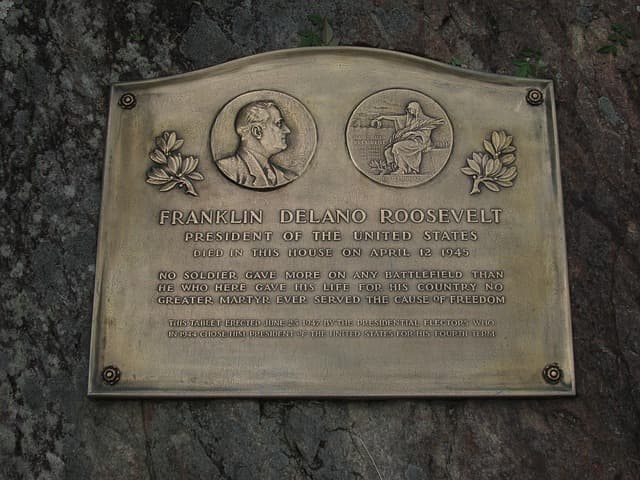
Franklin Roosevelt’s house is also known as Springwood Estate. President Roosevelt literally spent an eternity here: he was born in this house, lived in it, and was later buried on its grounds. Little is known about the early history of the estate. It is believed that the main part of the mansion that has survived to this day was formed on the basis of a farmhouse built in 1800 in the Federal style. In 1845, the estate was purchased by Josiah Wheeler, a merchant from New York City. He rebuilt the house to suit his needs, expanded it, and decorated it in the Italian style that was fashionable at the time, adding a three-story tower to the south side of the building and two verandas, front and rear, which extended the overall length of the mansion. After the renovation, the house had 15 rooms.
In 1866, James Roosevelt, father of President Roosevelt, purchased the mansion for $40,000 at a time when a textile factory worker earned less than a dollar a day. The estate had a stable and a road for horse riding, which was important because James was passionate about breeding horses. From the moment he bought the house until his death, he spent a lot of time improving the building: James enlarged the servants’ wing, added two rooms, and built a spacious garage for carriages.
Franklin was born in 1882. As a child, he occupied one of the rooms on the second floor of the tower. His sons also grew up there. In 1905, he married Eleanor Roosevelt, who moved in with her husband and mother-in-law. The estate remained the Roosevelt family home and the center of their lives throughout the president’s career. In 1915, Franklin Roosevelt and his mother Sarah undertook the last major expansion of the estate. This was done to accommodate the president’s growing family and to create a place for Roosevelt to socialize with his political colleagues, which was in line with his ambitions. The house was almost doubled in size with the addition of two huge extensions, designed by Roosevelt himself, a tower, and a third floor with a flat roof.
After the exterior was changed, the estate began to resemble a colonial revival mansion. The interior was altered to accommodate Franklin’s growing collection of books, paintings, stamps, and coins. The renovation of the house was completed a year after it began. Roosevelt also changed the landscape surrounding the house by planting many trees: in total, more than 400,000 trees appeared around the estate on his orders.
While Roosevelt was president, Springwood was visited by prominent political figures, including King George VI, Queen Elizabeth, Canadian Prime Minister William Lyon Mackenzie King, British Prime Minister Winston Churchill, Queen Wilhelmina of the Netherlands, and Crown Prince Olav of Norway.
In 1943, Roosevelt transferred the estate to the people of the United States on the condition that his family retain the right to use the building. After the Roosevelt family relinquished this right in 1945, the mansion was transferred to the Department of the Interior. It is now maintained as a historic landmark by the National Park Service. The estate is open to visitors.
The Roosevelt Estate is located at 114 Estates Lane, Hyde Park. It can be reached via Route 9, 90 miles north of New York City and 70 miles south of Albany. The mansion is open to visitors year-round, seven days a week, by guided tour only.